

12 Commercial Property Maintenance Tasks Vancouver Property Managers Should Schedule Every Year
If you manage a commercial property on Greater Vancouver, you know that a commercial property maintenance checklist is only useful if it reflects the realities of the area’s specific climate. A generic list built for a different region will inevitably leave gaps—gaps that quickly turn into emergency calls, tenant complaints, or tense board meetings when nobody can confirm when the irrigation system was last serviced.
Whether you are evaluating a Vancouver property maintenance vendor for the first time or auditing an existing partner, this checklist lays out the 12 essential tasks that belong on every North Shore grounds maintenance schedule. Below, we break down these requirements month by month, and outline exactly what you should expect your contractor to document at every stage.
For a broader look at what a comprehensive, full-service contract should look like, see our guide to commercial property maintenance in Greater Vancouver.
Why a Scheduled Checklist Matters More Than Reactive Maintenance
There are two ways to run a property maintenance program:
- Reactive maintenance: A crew shows up only after something breaks.
- Scheduled maintenance: The same tasks happen at the same time every year, regardless of whether a problem is visible yet.
While a documented seasonal maintenance plan takes more upfront coordination, it is always the most cost-effective option. For example, clearing a clogged irrigation head is a quick, inexpensive fix in July, but leaving it unnoticed until September can easily ruin the lawn, forcing a costly turf replacement.
Moving from a reactive mindset to a scheduled one comes down to two major pressures: our local climate and your legal obligations.
The North Shore’s Compressed Calendar
Timelines matter more on the North Shore than in other regions because of our prolonged wet season. Metro Vancouver’s rainy period runs from September through April, which compresses the bulk of active commercial property maintenance—and critical winter preparation—into a narrow dry window.
Because that window is so short, tasks like clearing catch basins and blowing out irrigation lines must be scheduled well in advance. Without a documented grounds maintenance schedule, these vital fall prep tasks get overlooked. The result is predictable: properties end up facing emergencies in January—after a hard freeze splits an un-winterized pipe or a leaf-blocked drain floods a walkway. This is when contractors are at their busiest, and emergency repair rates are at their highest.
Strata Governance & Due Diligence
For strata-adjacent properties, a documented schedule is also a legal shield. Under BC’s Strata Property Act, strata councils carry an ongoing duty to maintain and repair common property.
A dated, task-by-task record is the difference between showing a defensible history of due diligence to your board or owners, and offering a vague assurance that maintenance is simply “handled.”
The 12-Task Annual Maintenance Checklist for Vancouver Properties
1. Spring Irrigation System Start-Up and Inspection (March–April)
Before the growing season begins, every zone needs to be confirmed active and every head checked for winter damage. Freeze events commonly crack risers or dislodge fittings, and these faults are easy to miss until a dry patch appears in the lawn weeks later. This is also the time to reprogram timers for longer daylight hours and to confirm the system is set up to comply with Metro Vancouver’s water restriction stages. Stage 1 typically begins May 1, and a system that isn’t pre-adjusted will need an emergency reprogramming right at the start of peak season. A contractor should document which zones were tested, any repairs that were made, and the controller’s new schedule.
2. Spring FertiliZation and Pre-Emergent Weed Control (April–May)
Timing is everything here. Pre-emergent herbicide has to go down before soil temperatures reach roughly 10°C in order to be effective, which on the North Shore usually means early to mid-April. Spring fertilization sets the nutrient foundation for the whole growing season, and a quality contractor will assess turf condition—ideally with a soil test—before choosing a product rather than applying the same blend to every property. Note that BC restricts a number of pesticide products, so any application has to be carried out by a licensed applicator. Ask to see a service record showing what was applied, at what rate, and on what date as this is the kind of documentation a board or owner will expect to see if questioned.
3. Hedge and Shrub Shaping — First Cut (May)
Commercial sites with formal hedging—a common feature on North Shore office parks and strata complexes—need a precise first cut in May, once the spring flush of new growth has extended enough to shape. There’s an important distinction between a routine maintenance trim and a structural shaping cut, and it’s a common failure point for new contractors to do one when the property actually needs the other. Laurel hedging, cedar hedges, and ornamental grasses are all common in North Vancouver commercial landscapes, and each has different timing needs. Hedges near property lines or fencing also carry legal weight: work should never encroach past the boundary, even by a few inches.
4. Lawn Mowing Program Start and Frequency Setting (Late March–Mid October)
Commercial turf on the North Shore typically needs weekly mowing through the growing season (May through September) as part of a well-run commercial grounds maintenance program. A proper grounds maintenance schedule includes edging and blowing of hard surfaces after every cut—it’s the detail that separates a maintenance contract from a casual mow-and-go arrangement. Height matters too: North Shore lawns shouldn’t be cut shorter than 2.5–3 inches in summer, since that extra length helps retain moisture during dry spells and holds up better under foot traffic. Check out our commercial property services page for more detail on what we offer at Eco Property Maintenance.
5. Garden Bed Maintenance and Annual Colour Rotation (May and September)
Properties with entrance gardens or tenant-facing landscape beds benefit from seasonal colour changes – spring annuals like pansies, petunias, and begonias swapped out in September for fall and winter interest plants. At minimum, garden bed maintenance should include edging, weeding, mulch top-up, deadheading of spent flowers, and basic pest or disease monitoring. A 2–3 inch layer of bark mulch reduces weed pressure, retains moisture, and protects roots through North Shore winters. Ask your contractor for a written planting schedule at the start of each season, not a verbal promise.
6. Tree and Shrub Health Inspection (June)
A visual inspection by a qualified arborist or experienced horticulturist should happen annually – not only when something already looks wrong. Common issues on North Shore commercial sites include phytophthora root rot in poorly drained soils, bronze birch borer in birch trees, and root uplift damaging nearby hardscape in mature landscaped areas. WorkSafeBC requirements also apply here: any tree work at height requires a qualified contractor, and ground-level staff should never be authorised to undertake chainsaw work themselves. Eco Property Maintenance can advise on tree health issues directly and coordinate specialist arborist work when needed.
7. Irrigation System Monitoring and Mid-Season Audit (July)
A mid-summer audit keeps your irrigation system running efficiently when water demand peaks. It catches mechanical issues before July heat damages your turf, while preventing the unmonitored “autopilot” runs that cause costly over-watering complaints. A system check at this time also ensures watering schedules are adjusted to match Metro Vancouver water restrictions, which typically tighten in July. Finally, when your contractor documents these precise adjustments, you get a ready-made paper trail of compliance to show building owners or your strata board.
8. Late-Summer Turf Assessment and Overseeding (September)
September is when North Shore lawns show the accumulated stress of the season: thinning areas, bare patches from summer foot traffic, and moss creeps into shaded zones during the fall. Overseeding thin areas in September takes advantage of warm soil and the onset of fall rain, giving new seed the best possible germination conditions. If the thatch layer exceeds 1 cm, dethatching should happen at this point too, since excess blocks water penetration and encourages disease heading into the wet season. A property manager should request a written turf assessment from their contractor around this time each year.
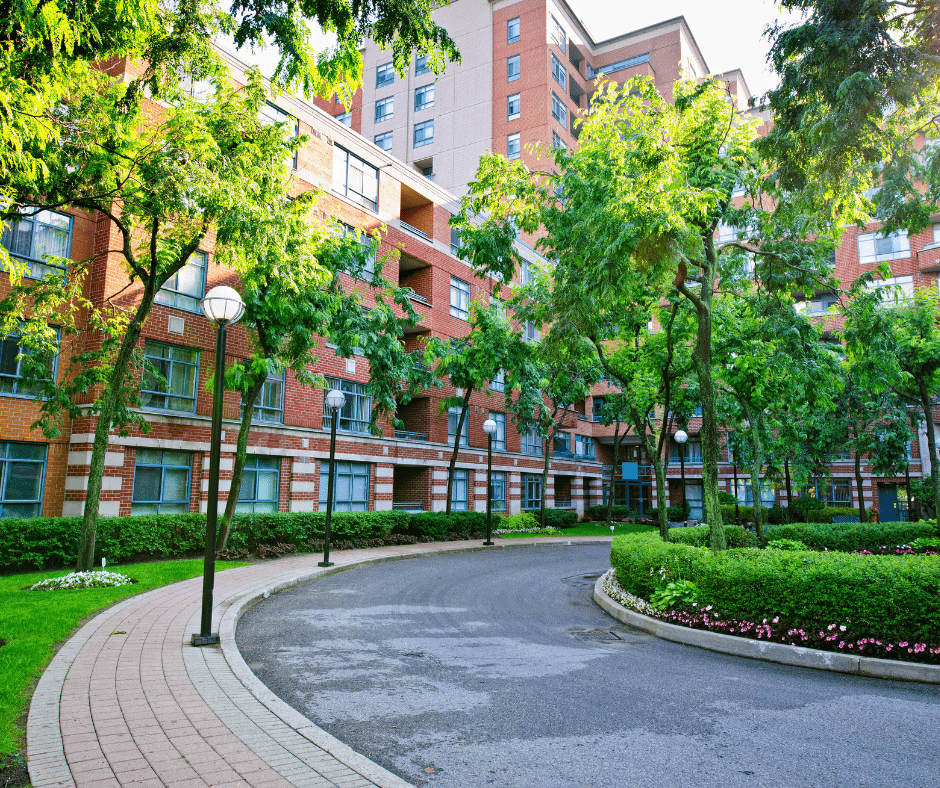
9. Fall Clean-Up Program — Leaf Management (October–November)
This is the most labour-intensive stretch of the calendar. Mature deciduous trees—maples, chestnuts, birches—generate a heavy volume of leaves from October through December. Weekly leaf clearing isn’t optional on a commercial site; wet leaves pack down on turf, block drains, create slip hazards on hard surfaces, and attract pests if left to accumulate. We’ve written about the residential side of this in our Complete Guide to Fall Yard Clean-Up in Vancouver and commercial sites face the same challenges, just at a larger scale. Drain and catch-basin clearing is part of this task as well—a blocked catch basin on a commercial property is a liability issue, not just a maintenance one.
10. Irrigation System Winterisation (October–November)
Lines need to be purged and the controller disabled before the first frost, which on the North Shore typically falls somewhere between late October and mid-November. Our winters are mild enough that hard frosts are infrequent, but when they do occur, a system that hasn’t been winterised can suffer split PVC lines that aren’t discovered until spring start-up. Commercial systems often involve multiple zones, booster pumps, and backflow preventers, so this task should be handled by a contractor who knows the specific layout, not a general labourer working from a generic checklist. The shutdown date and final controller settings should be documented so they can be referred back to at spring start-up.
11. Snow and Ice Management Plan — Activate Contract (November)
A snow and ice management protocol must be established before the first freeze, not scrambled together during a storm.
Typically, winter service levels fall into three clear categories:
- Reactive: Service is triggered only when you call the contractor out.
- Proactive: Service is triggered automatically based on the local weather forecast.
- Hybrid: A customized combination of both scheduled and on-call response.
Regardless of what type of service you choose, make sure to align early on who authorizes salting, which products are approved for use, and what response-time SLA is in place.
To streamline snow and ice removal services, Eco Property Maintenance keeps your regular grounds care and winter weather response under one coordinated team, rather than forcing you to manage two separate vendors.
12. Year-End Review and Contract Renewal Planning (December)
A professional service contractor should close out the year with a summary of what was completed, any issues flagged along the way, and recommendations heading into the next season.
December is also the natural point to use this summary to review the contract itself: does your service frequency still match the property’s needs, or has the site physically changed with new plantings, new tenants, or boundary adjustments? These details feed directly into next year’s budget planning, which must factor in contingencies for plant replacements, hardscape repairs, and any tree work flagged during your June inspection.
For strata-managed properties, our blog post on strata spring maintenance reviews breaks down how to run this parallel review and budgeting process with your council.
Using This Checklist to Evaluate Your Current Contractor
This list doubles as an audit tool. Sit down with your current contractor and ask which of these 12 tasks are already built into your contract, which are billed as extras, and which have simply never come up.
If they cannot produce dated service records for these four critical, easily neglected tasks on request, that is a red flag worth taking seriously:
- Spring Fertilization & Weed Control (Task 2)
- Tree & Shrub Health Inspection (Task 6)
- Mid-Season Irrigation Audit (Task 7)
- Late-Summer Turf Assessment (Task 8)
Of course, no two commercial properties require the exact same maintenance plan. For example, a parking-lot-only property has a very different maintenance profile than a campus-style development with extensive grounds. What matters is that your contractor can explain, task by task, which items apply to your site and why—not simply run a standard package regardless of fit. For a full breakdown of what this type of contract should include, read our guide to commercial property maintenance in Vancouver.
If you’re building out your property management plan for the first time, it helps to separate your checklist into two tiers, both of which are important:
- The non-negotiables that protect the property from liability and costly damage: irrigation winterisation, tree inspection, snow and ice management
- The tasks that protect appearance and tenant experience: colour rotation, hedge shaping, mowing frequency.
Ready to Review Your Maintenance Program?

Reviewing a maintenance program takes time, and it’s reasonable to want to get it right before committing to changes. The right contractor makes that process straightforward rather than complicated; they will walk your site with you, map what’s already being done against what should be, and be upfront about the gaps.
If you’re searching for a reliable commercial property maintenance partner on the North Shore or elsewhere in the Greater Vancouver area, we’d be glad to do a site visit and show you what a proper maintenance program looks like. Call 778-886-3458 or send us a message.
Summary
This commercial property maintenance checklist walks Vancouver property managers through 12 essential seasonal maintenance tasks, from spring irrigation start-up to winter snow prep. Use it to audit commercial property maintenance services, build a grounds maintenance schedule, and find a reliable commercial property maintenance partner.
Tags: